
UniSharp 29G Syringes: Reading the Accessory Listing
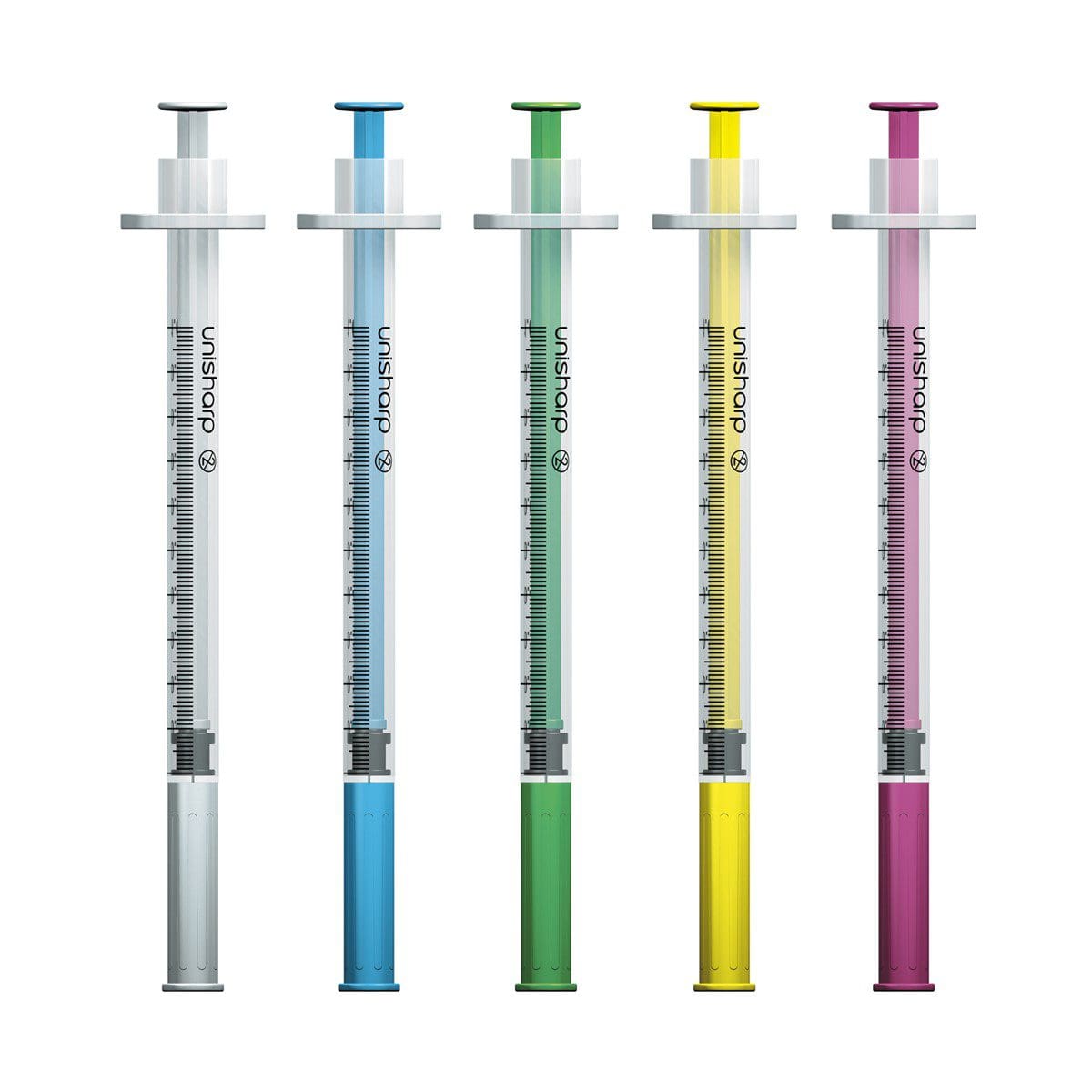
A 29G description refers to a needle gauge, while “10 x” refers to quantity. Those specifications can help compare packaged accessories, but they do not make an injection appropriate or risk-free.
For the named accessory, the ten-pack UniSharp Nevershare 29G listing states a 1ml capacity and fixed 29G needles. Read the package to check the model and specifications.
Which details belong on the listing
Confirm the stated count, manufacturer, gauge and packaging condition on the current product page. A generic image cannot verify the specifications of every unit shipped.
Sterile packaging has limits
A sterile claim relates to a sealed, correctly supplied item under stated conditions. It does not establish the safety of a substance, a technique or an entire procedure. This article gives no instructions for injection.
Do not transfer accessory claims
The site’s accessory overview explains the category. Cancer Research UK separately cautions against marketed Melanotan injections and sprays; a compatible-looking syringe does not resolve that concern.
Further reading: accessory overview, Cancer Research UK.
Read precision as a measured claim rather than a label
A precise-looking scale and a precise-sounding advertisement are not measurement results. The relevant question is which property was assessed, under which conditions and against which reference. This guide explains that reading distinction without describing syringe operation, calculating an administration quantity or assigning an accuracy specification to a retail item.
Distinguish a graduation from a measurement result
A printed graduation is a feature of the item shown. A measurement result is an observation obtained by a defined method. The presence of the feature does not, by itself, supply the observation. An article should identify whether it is describing markings, reporting a completed assessment or merely repeating a performance adjective from a listing.
Imagine a catalogue image showing clear marks beside a statement that the accessory is accurate. The image can support an account of the marks visible in that image. It does not contain a comparison with a reference, a record of test conditions or a result for the particular packaged item eventually supplied to a customer.
The object of an assessment matters as well. A test report may concern a named model, a particular submitted sample or a defined group of items. Those subjects are not interchangeable. Before extending a result, establish the relationship between the report’s subject and the selected presentation rather than relying on a familiar product family name.
A figure appearing in a specification also needs its own label. A declared capacity, a dimension and a test result answer different questions. The number should not lose its original property name when it moves into a summary. Otherwise an ordinary descriptive field can acquire the appearance of a measured performance assurance.
An unsupported adjective does not establish that an item has failed a test either. The limitation is that the evidence needed for that particular claim has not been supplied in the statement being read. Keep the descriptive fact, the proposed conclusion and the missing comparison separate so that the account neither invents reassurance nor invents a defect.
Keep repeatability separate from agreement with a reference
Repeated observations and agreement with a reference are separate ideas. A series of observations can resemble one another while leaving its relationship to a suitable reference unanswered. Conversely, a single reported comparison does not describe how observations varied across repetitions. A careful account identifies which question the source actually assessed before using a broad adjective.
The NIST terminology discussion treats accuracy, precision and repeatability as concepts requiring careful use and a stated measurement context. Its role here is to clarify language, not to certify a syringe, assign a retail tolerance or create a consumer testing method. A label cannot substitute for the missing assessment record.
For a fictional document comparison, one source discusses repeated observations under named conditions and another discusses agreement with a reference. Calling both simply precise discards their different subjects. A later summary should preserve the reported property and conditions rather than merge two unlike assessments into one general promise about performance.
The relevant conditions belong with the result. A different model, method or observation setting may change the question being answered. A report need not be dismissed because it has a defined scope; that scope is what makes it interpretable. The error is extending the conclusion to a setting or item that the report has not identified.
The separate dimensional-claim article explains why even a correctly identified physical property does not establish every performance or clinical endpoint. A clear comparison can retain the narrow assessment while leaving those additional outcomes open. It should not turn measurement vocabulary into a claim about comfort, medical appropriateness or an individual’s result.
Ask what a precision statement actually measured
Start with the full sentence containing the performance word. Ask what it says was measured and what record is cited for it. A phrase may refer to a product design, a reader’s impression or a documented observation. Those meanings should be stated rather than selected by the reader according to which interpretation sounds strongest.
If a source reports a result, keep its unit, subject and method together. A result without those relationships can be copied accurately as a number yet become misleading as an explanation. Quoting another item’s value would not close the gap. Nor would replacing the absent unit with a familiar term from the product title.
Our unscored comparison guide shows the wider consequence. An incomplete performance field cannot be converted into a convenient overall ranking between alternatives. A catalogue difference and a measured advantage need different supporting information. Leaving the field unresolved is more informative than awarding a favourable score to the best-described listing.
A request for clarification should identify the claim and ask for its matching record. It should not ask a seller to reconstruct a personal procedure from a capacity, gauge or picture. A supplied document can then be read for the precise property it addresses, with clinical questions kept outside the commercial specification enquiry.
The useful outcome is a description that says what is printed, what was actually assessed and what remains unsupported. That approach makes the accessory comparison more exact without creating a new technical specification. It also avoids presenting a visible graduation, a repeated marketing word or a named device as proof of the identity or suitability of another product.
References checked: 15 November 2026.