
What Is Included in a M2UK Tanning Injection Starter Kit?
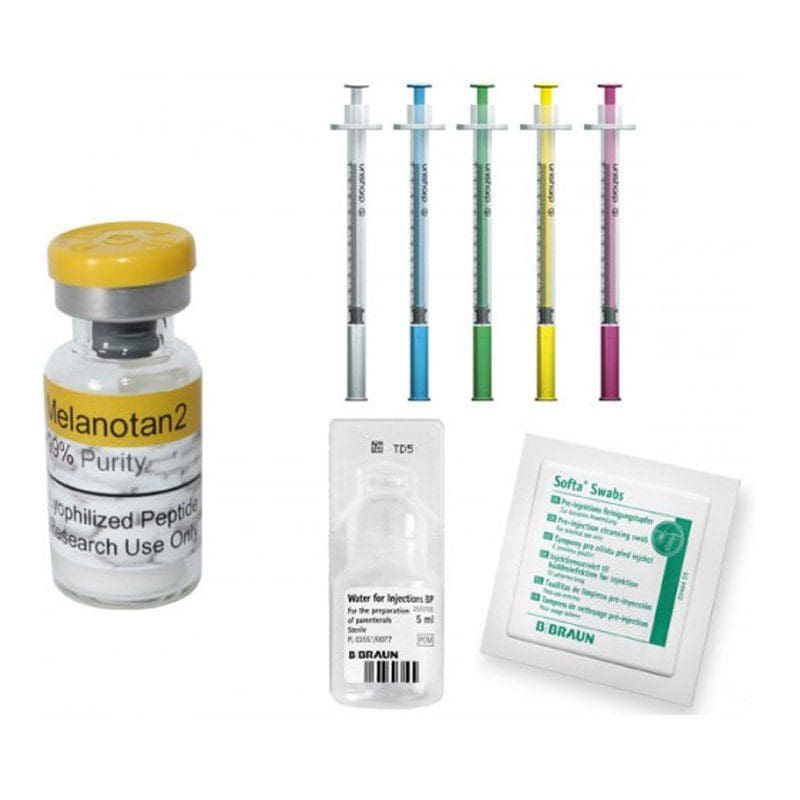
M2UK’s injection starter kits combine Melanotan 2 vials, injectable water, insulin syringes and pre-injection wipes in a single listing. The product title often compresses these into a short string of numbers and labels. Understanding what each label refers to makes it easier to read the contents accurately, particularly where a quantity, a container volume and an amount in milligrams appear together.
This guide explains the items in those kits. The Melanotan 2 product formats introduces the other product formats in the catalogue.
The four listed components
The title and detailed description use different names for some of the same items. “Pins” refers to the insulin syringes named in the descriptions; “swabs” refers to the pre-injection wipes. These are separate components, so the number beside one label should not be carried across to another.
| Label in the listing | What it describes | How to read the quantity |
|---|---|---|
| Melanotan 2 vial | The vial containing the stated amount of Melanotan 2. | One 10mg vial is one container; 10mg is the amount stated for that vial. |
| Water | Containers named Injectable Water in the descriptions. | A count of one water container and its stated 5ml volume are different measurements. |
| Pins / insulin syringes | The 1ml insulin syringes named in the contents list. | 11 syringes means 11 supplied items; 1ml describes each syringe’s capacity. |
| Swabs / pre-injection wipes | The wipes named in the contents list. | 11 wipes is an item count, separate from the number of vials. |
For example, a title containing “1 vial, 1 water, 11 pins, 11 swabs” names four groups of items. It does not mean that every component has the same count. Reading the labels alongside the description avoids confusing a small vial count with the larger number of accessories.
Water name and container size
M2UK describes the kit water as Injectable Water and lists 5ml containers. The name identifies the item being supplied; the volume identifies the size stated for its container. Neither tells you how much to add to a vial. A contents guide should not be used as a mixing instruction.
Keep the measurements attached to their own items: 10mg belongs to the stated vial amount, 5ml to the water container, and 1ml to the syringe capacity. Milligrams and millilitres describe different things. The number 1 in “1 vial” is a count, not another way of expressing either measurement.
Do not replace the listed water name with a more specific description such as bacteriostatic water unless the selected listing explicitly confirms it. If the title and description use conflicting names, that is a detail to clarify with the seller before ordering.
A complete example: the one-vial kit
The one-vial starter kit lists one 10mg Melanotan 2 vial, one 5ml water container, eleven 1ml insulin syringes and eleven pre-injection wipes. Those four entries describe the supplied contents of that particular kit; they are not a general definition of every product sold under the word “starter”.
The accessory counts do not establish a dosing schedule or the number of times a product should be used. Likewise, the amount in the vial does not establish how long a kit will last. The purpose of the example is to make the listing readable, without turning an inventory into a treatment recommendation.
The larger kits have separate contents lists. The 1, 2, 3 and 5 vial kit comparison puts their quantities side by side, so you can check a different pack without assuming that its title describes the same order.
Kits, separate accessories and missing details
A kit is a bundle of the named items. A standalone-vial listing is a different order type: the vial-only descriptions exclude water, syringes and swabs. Adding more vials does not by itself add those accessories. An accessory bundle also needs its own contents check; its photograph or name is not a substitute for the item list.
The injection starter kit catalogue brings the kit listings together. Within the selected listing, check that the component names and counts agree. Do not assume that an instruction leaflet, an extra container or another accessory is included simply because the product is called a starter kit.
If a detail is missing, ask about that specific item and identify the product concerned. A clear question is whether the named accessory is supplied and in what quantity, rather than whether the kit is “complete”, which can mean different things to different readers.
Listed contents are not evidence of safety or effectiveness. DermNet’s information on Melanotan II provides a separate medical reference on the substance and its risks.
Turn a compressed kit title into a clear item record
A compressed product title can be expanded into a clear record without adding any unstated information. Give each named component its own line, keep the count and measurement in separate fields and retain unresolved wording as a question. The aim is to preserve the meaning of the title, rather than to turn its sequence of numbers into a procedure.
Expand each abbreviation before comparing quantities
An abbreviation should be read alongside the full component name used in the selected description. A shortened label may be convenient in a title while the detailed list explains its subject. Keep that full name in a comparison note so that the same abbreviation is not later applied to another item.
For a hypothetical example, imagine a title naming a vial and two accessory types. Expanding the accessory labels does not change their counts or establish an additional component. It simply makes the nouns explicit. A clearer account should preserve every stated distinction while leaving an unrecognised label unresolved.
Do not use a familiar abbreviation to infer a specification that the listing does not give. The name of an item and the properties of that item are separate fields. A recognised component name can still leave a capacity, manufacturer or other detail unstated.
Keep container count apart from the unit after the number
The number before a component name can count supplied objects, while a measurement elsewhere in the same phrase describes a property of each object. Retain both labels. If a shortened note loses the item name or unit, another reader may no longer know which kind of quantity the number represents.
The same numeral appearing twice does not make the fields equivalent. One can describe a container count and another a stated capacity. The existing component table keeps these questions apart. A summary should preserve that separation rather than collapsing the entries into a single unexplained total.
A quantity record is complete only for the fields actually stated. It does not become a mixing ratio, number of applications or expected duration. Those conclusions require information and judgements outside the item list. The arithmetic of an inventory cannot provide them by itself.
Use an unresolved label as a precise support question
A useful clarification identifies the selected product and the exact label that is unclear. Ask whether the wording names an included item, a quantity or a specification, rather than asking whether the kit is complete in an undefined sense. The answer can then address the missing field directly.
Keep that clarification with the version of the description that prompted it. A later title may use clearer wording, but it should not silently replace the record of an earlier question. The purpose is a readable, traceable inventory account that retains all original quantities without filling gaps by assumption.
References checked: 14 November 2026.