UVA, UVB and UVC: Differences Relevant to Sun Safety
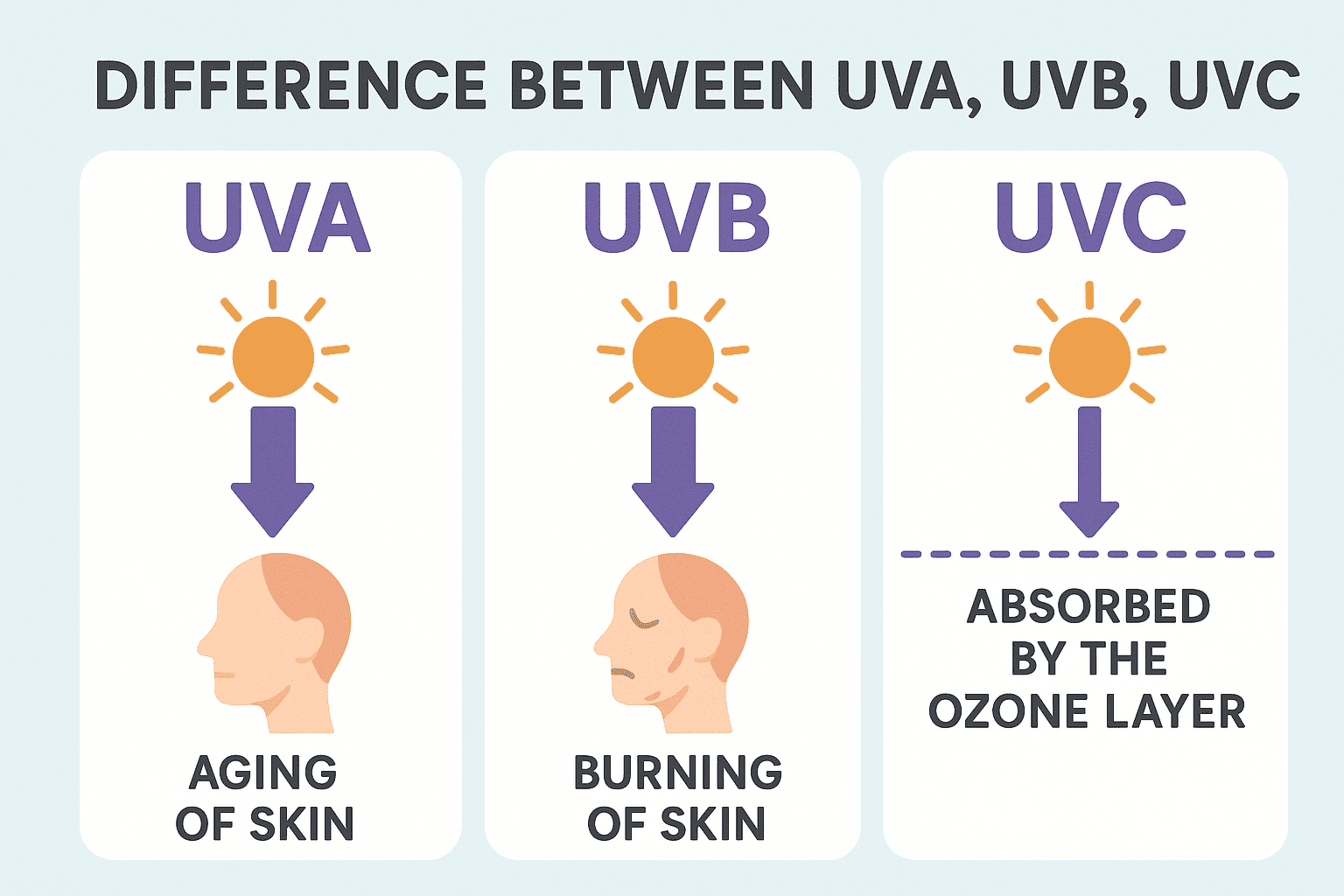
Ultraviolet radiation is grouped into UVA, UVB and UVC by wavelength. These are physical categories, not labels for “good” and “bad” tanning. The amount that reaches a person and the biological effects differ across the bands.
Which bands reach the surface?
The World Health Organization defines UVA as 315–400 nm, UVB as 280–315 nm and UVC as 100–280 nm. UVC from the sun is filtered by the atmosphere and does not reach Earth’s surface. UVA accounts for most of the UV that reaches the ground; some UVB reaches us and contributes to sunburn and skin damage.
Why the distinctions matter
UVA and UVB can both be relevant to skin damage. A statement that one band darkens skin while another burns it is too simple to be a safety rule. Sunbeds are also artificial sources of concentrated UV. A tan is not proof of protection from further exposure. For the individual-response question, read why skin responses differ.
Use protection, not a product shortcut
NHS sun-safety advice recommends shade, clothing and sunscreen when needed; Cancer Research UK says there is no safe UV tan and warns against Melanotan products. Our UV Index guide explains how conditions change. No peptide or cosmetic colour changes the definitions of UVA, UVB and UVC.
Separate wavelength names from exposure claims
UVA, UVB and UVC classify parts of the ultraviolet spectrum. The names help describe radiation, but a band label does not tell the whole story about an exposure or establish what a product does. The notes below focus on reading those statements, while preserving the existing definitions and sun-safety guidance above.
A band name describes wavelength rather than a complete outcome
The WHO account of ultraviolet radiation distinguishes UVA, UVB and UVC by wavelength. Those labels are a classification, not three simple promises about tanning, burning or safety. A statement that names a band still needs to identify the source and the outcome being discussed before the reader can understand the claim.
For example, calling a source UVA does not by itself identify how strong it is at a particular place, how the observation was made or which outcome was measured. Adding a scientific label can make a sentence sound specific while leaving its central assertion unanswered. Keep the category name separate from any numerical result or biological conclusion attached to it.
The existing general UVA, UVB and UVC overview provides the wider introduction. This section addresses the narrower reading problem: how a claim can move from a correct band name to an unsupported conclusion. Knowing the name is a starting point for understanding the statement, rather than a substitute for the missing measurement.
Do not compare numbers that describe different quantities
A wavelength, a share of a spectrum and a time interval are different kinds of information. A claim may place such numbers close together without explaining their relationship. Before comparing them, identify what each number measures and which units belong to it. A precise-looking figure is not useful if its quantity has been lost in the shortened description.
Imagine a chart that labels two sources with different band names but gives no measurement method or relevant output information. The chart has identified a category difference; it has not established a complete exposure comparison. Replacing the missing measurements with a phrase such as stronger or gentler would add a conclusion that the labels alone do not supply.
A percentage also needs its reference quantity. A statement about the share of radiation in one band is not automatically a percentage of protection or a percentage change in an outcome. The explanation should show which quantity is being divided or compared. If it does not, do not silently reuse the number as an answer to a different question.
Keep solar and artificial-source descriptions in their own settings
WHO describes how the atmosphere filters solar ultraviolet radiation before it reaches the ground. That account concerns sunlight passing through the atmosphere. It should not be copied into a statement about a particular artificial source without identifying what that source emits and how the relevant observation was made. Sharing a band name does not make the settings identical.
A laboratory record, an equipment description and an outdoor forecast serve different purposes. An equipment label is not a weather report, and a weather report does not assess an individual lamp. A comparison should state the setting on both sides. Missing source information cannot be supplied by a product photograph, the cleanliness of a room or the appearance of a person’s skin.
The UV forecast and product-claim explanation addresses the related distinction between an environmental indicator and a protective effect. Read together, the two guides help keep wavelength classification, the exposure setting and a claimed product outcome from being collapsed into a single unsupported statement.
Read a protection label by the measure it actually reports
The NHS explanation of sunscreen labels distinguishes SPF, relating to UVB protection, from the UVA protection information on the label. These are specific label measures. The presence of UVA or UVB in a different product description does not establish that the item has been assessed in the same way or carries a comparable result.
This matters when a claim moves from a change in skin colour to the language of shielding or protection. The appearance observation does not provide an SPF value. Nor does a familiar spectrum diagram turn an undefined benefit into a measured protective effect. Keep the claimed endpoint visible and ask whether the cited record actually assesses it for the named preparation.
A useful explanation therefore identifies the band, source, measured quantity and outcome, then states which parts remain unknown. This is a way to read evidence, not a method for calculating an exposure time or choosing a tanning product. The existing guidance above remains the practical reference for sun protection; a band name should not be used to create an exception to it.
Missing measurements do not establish that two sources are equivalent either. If a comparison gives only labels, the unexplained parts remain unexplained in both directions. It is equally unsupported to announce a winner or to claim identical effects. The appropriate description preserves the limits of the comparison instead of choosing whichever conclusion best suits a sales message.
References checked: 13 November 2026.