
Alcohol Swab Sterility Claims and Pack Conditions
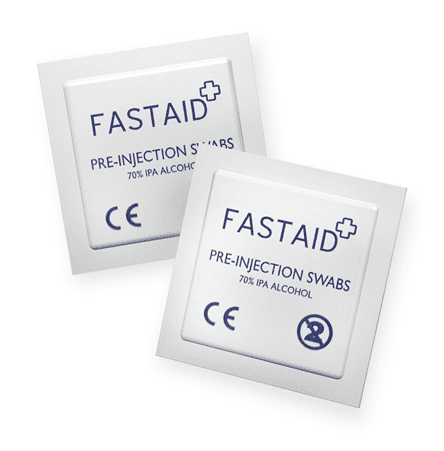
A swab packet can carry a material, alcohol-content or sterile-packaging claim. Those words apply to the item under its labelled conditions, not to every aspect of an injection procedure.
Read the package conditions
Check manufacturer, quantity, intact wrapping, expiry and any stated single-use condition on the current pack. The “10 X” title is a count, and a photograph of two sachets is only illustrative.
One accessory is not a safety system
Buying a swab does not establish that a peptide is authorised, that the equipment is appropriate or that a procedure is risk-free. This article does not provide preparation or injection steps.
Separate product specification from health claims
Our accessories guide covers how listings describe water, swabs and syringes. Cancer Research UK’s warning about marketed Melanotan products remains separate from the specification of an accessory.
Further reading: accessory listing guide, Cancer Research UK.
Keep a sterile-packaging claim with the labelled unit
A sterile-packaging statement has a subject and a boundary. The packet named by a label, the condition of a particular item and the documentation describing a packaging system are connected questions, but they are not the same record. Reading them separately helps prevent a limited packaging claim from becoming an assurance about everything associated with an accessory.
Identify which packet the statement describes
Identify the physical unit before interpreting the statement. An outer box may name a product family, while an individual packet carries a more specific identifier. A retail photograph may show an example from either level. The wording should make clear which object is being described; a familiar appearance alone does not establish that every representation refers to the same unit.
For an illustrative record comparison, an outer carton names a model while a pictured sachet has no readable identifier. The carton supplies a model statement. The image supplies an appearance. Matching them requires a documented connection; the reader should not complete that connection by assuming that a shared colour or layout establishes an identical labelled item.
A catalogue title can also shorten a fuller name. That may be useful for navigation, but the omitted wording can matter when asking about a particular packet. Retain the identifier actually supplied by the relevant record. A clarification should say which presentation it concerns rather than treating every similarly named swab as interchangeable.
Different quantities can describe different levels of the same order. The number of retail packs and the number of individual units within a pack should not be merged. A packaging statement about one individual unit should remain attached to that unit. Expanding a count does not expand the evidential scope of a sterility claim.
Where a source cannot be tied to the selected item, leave that connection unresolved. It is reasonable to ask the seller which label, presentation or manufacturer document its statement concerns. That is a request for product information. It does not require guessing how the item would be used or treating a seller response as personal clinical advice.
Retain the conditions beside the packaging statement
Conditions are part of the claim, rather than optional words beside it. A statement referring to a supplied, unopened presentation cannot be read as a statement about an item with an unspecified history. Removing the condition may leave the same reassuring adjective while changing the proposition being made. Preserve the qualification when comparing descriptions.
The public abstract of ISO 11607-1 concerns packaging systems for terminally sterilised medical devices. It illustrates that a packaging assessment has a defined subject and purpose. The abstract does not identify a particular M2UK accessory, verify a delivered packet or establish that a retail item complies with the standard. The full standard is not reproduced here.
An illustration of an intact packet and an account of a particular delivered item are different evidence. The illustration describes what was photographed. The item account needs its own identifier and observations. One should not be used to overwrite an inconsistency in the other, and a stock photograph should not be treated as an inspection record for every order.
Dates need their subjects too. A label date, a document issue date and the date someone viewed a listing describe different events. A recent webpage does not by itself establish a new packaging assessment. Keep each date with the object or document it identifies, particularly when the records appear current for different reasons.
If the condition or identity is uncertain, the description should retain that uncertainty. An incomplete record is not improved by replacing the missing information with a general reassurance. A useful response identifies which field has been clarified and the evidence relevant to it. It does not silently make the clarification apply to every item or later circumstance.
Do not extend a barrier statement to a whole process
A barrier statement concerns the packaging subject it names. It does not independently assess another substance, every component supplied alongside it or the combined process someone has in mind. Placing several items in one bundle does not merge their separate evidence. The scope of an accessory statement should remain visible even when the surrounding catalogue presents a complete-looking arrangement.
The swab label-purpose explanation considers how an intended-purpose statement can be enlarged through seller wording or reader assumptions. That is distinct from the packet-condition question here. A clearly attributed purpose does not settle the condition of a particular packet, just as a packaging statement does not settle every use-related question a reader might ask.
The separately listed supplies guide provides the commercial context for the different accessory categories. It helps identify which listing is under discussion. It should not be read as a certificate covering the whole catalogue, a compatibility finding or a substitute for the document attached to the particular object whose property is being questioned.
A complete-looking checklist can obscure this boundary if every item is marked reassuring without identifying the corresponding evidence. It is clearer to retain the source and scope of each statement separately. One resolved field can coexist with several unresolved questions. A packaging observation does not have to become an all-purpose conclusion in order to be useful.
The finished account should say which labelled unit is being discussed, what condition is stated and what source supports that statement. A seller can clarify those listing facts. Questions about personal suitability or a proposed procedure require a different assessment and are not answered by turning a packet label into an assurance of an entire system.
References checked: 15 November 2026.