
Injectable Water Listing Claims
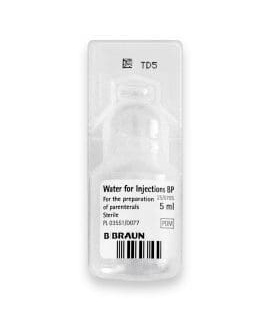
 The site’s Injectable Water listing describes one 5ml item. Its prose also makes claims about injectable grade, lack of preservatives and container composition. Those details should be assessed against the actual manufacturer’s label and product documentation, rather than inferred from a title or photograph.
Questions for a specific label
Check the stated manufacturer, product name, volume, ingredients, container, batch, expiry and the documentation accompanying the item. “Not rebottled”, “PVC-free” and “preservative-free” are particular assertions that require specific support. Do not treat another manufacturer’s licensed water-for-injection leaflet as proof of this site’s 5ml item.
Why “water” is not a use instruction
Clinical water for injection is a vehicle used with a compatible medicinal product under its authorised instructions. It is not automatically suitable for a retail peptide because the package says “injectable”. A licensed Water for Injections SmPC explains the compatibility and administration constraints for that particular medicine. This is context, not certification of the product on this article.
Related questions
For medical terminology, read the site’s standards article. For the narrower order question, compare the separate item with water named in a kit. No mixing directions or reliable-result promise follow from either listing.
Follow a water specification to the supplied presentation
A specification needs a traceable connection to the presentation being described. The chain can involve a seller field, a label and a manufacturer document, each with its own identity and date. The fictional records below show where that connection can fail without certifying the site’s water item or supplying preparation advice.
Separate a seller field from the document cited for it
Begin with the exact field in the seller description. A volume, a composition assertion and a packaging claim are different statements. Record which document is offered for each, rather than treating a linked file as support for the whole paragraph. A genuine source may address one field while leaving another unanswered.
Imagine fictional Listing W referring to Document R for a container claim. The document names a product, but its presentation differs from the one in the listing. The record establishes that a document was cited. It does not yet establish that the document’s statement applies to the particular retail object under discussion.
Retain the attribution when writing the summary. The seller describes the item as X identifies the origin of the statement. A matching manufacturer record confirms X is a different conclusion and needs a documented relationship. Removing the attribution can make an unresolved seller assertion look independently established.
The source’s subject matters more than the confidence of its layout. A professional-looking leaflet may concern a defined product without covering every similarly named item. A logo, a familiar volume or a common category term cannot supply the missing identity connection. Those similarities should be recorded as similarities, not used as automatic proof.
The useful first account therefore contains the field, the person or organisation making the assertion and the precise record cited. If no supporting document is supplied, retain that absence. It should not be completed with a specification borrowed from a different product merely to produce a more comprehensive-looking description.
Match the presentation before borrowing a specification
Presentation identity belongs with the document. A manufacturer may describe a particular container, product version or market presentation. Those details should remain visible when a statement is applied elsewhere. Matching one word in the title does not establish that every composition or packaging field applies to the item being supplied.
For a fictional example, Record R names Presentation A while an order description names Presentation B. Their declared volume happens to match. That shared field is not enough to connect the presentations. The comparison should retain the mismatch and identify the evidence needed to establish whether R actually covers B.
Document versions introduce another boundary. A revised leaflet may change its scope or wording without showing that the same information applied to an earlier presentation. A later publication date should not automatically be treated as a later test of an individual item. The document’s own identity and covered subject remain necessary.
A product-specific medical record also retains its medical context. It should not be transferred to an unrelated retail item through a shared water label. This explanation concerns how the records are connected; it supplies no compatibility finding, preparation method or instruction for using a product with another substance.
Where a clarification establishes the matching presentation, update only the fields it supports. A packaging answer does not become a composition result. A composition statement does not establish every property of a supplied item. The chain remains useful when its individual connections are recorded rather than replaced with a broad verified label.
Keep a document gap distinct from an inclusion question
An inclusion question asks whether the selected offer says an item is supplied. A document question asks which specification or record applies to that item. These can arise together, but an answer to one need not answer the other. Keeping them separate makes a follow-up question more precise.
Our mixed accessory-field explanation shows why a count, a dimension and a composition statement cannot fill one another’s missing fields. A stated inclusion count may be clear while the included item’s identity remains insufficiently documented. Repeating the count does not resolve that identity question.
Imagine a fictional kit confirmation naming a water item but providing no product identifier. The confirmation can support the inclusion statement. It cannot independently connect the item to an external manufacturer leaflet or verify every assertion in a separate product article. The missing link should be named instead of assumed from the kit title.
The separate-item and kit comparison above explains which items are included. This page follows the documentary chain behind a specification. Preserving those different roles avoids turning an inventory explanation into a certificate or treating a clinical document as though it were a complete record of an individual order.
The final note should identify the assertion, the cited record, the matching presentation and any unresolved connection. That gives the reader a checkable account without inventing a laboratory finding or a period of usability. A traceable source is valuable within its stated subject; it should not be expanded into a personal-use assurance.
References checked: 15 November 2026.