
Water for Injection: Clinical Context and Limits
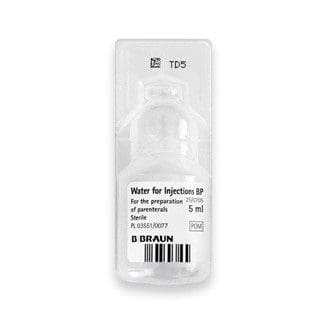
Water for Injection is a defined medical vehicle used with suitable medicines under their product-specific instructions. The phrase should not be treated as a general promise that any sterile liquid, or a retail product bearing a similar name, can be injected directly.
Clinical purpose
A licensed Water for Injections product is described as a solvent for diluting or reconstituting compatible medicinal products. The prescribed medicine’s directions determine the appropriate vehicle, formulation and method. Pharmacy and clinical practice also involve controls for contamination, stability and labelling, as described by the NHS Specialist Pharmacy Service.
Sterile does not mean suitable on its own
Sterile water is hypotonic. The licensed product information says it should not be administered alone and warns of haemolysis if used inappropriately. Sterility is only one property; compatibility, formulation, method and professional context also matter.
Read a particular product’s documents
Names such as water for injection, bacteriostatic water and an online “injectable water” listing do not establish equivalence. The site’s terminology article handles standards in more detail. Its separately sold 5ml item needs its own manufacturer and label evidence; the clinical SmPC is not documentation for that item.
Read a water product record without transferring its scope
A medical product record has a named subject. Manufacturer, presentation and formulation determine which finished product the document describes. The shared word water is not enough to join it to another item. Reading those identifiers first prevents a genuine medical document from being used as borrowed assurance for an unrelated retail listing.
Keep the document identity with its presentation
The Bio Products Laboratory product record on emc names Sterilised water for injections in 10 ml and 20 ml presentations. Its manufacturer and presentation details identify the subject of that document. They do not identify a different container merely because another listing uses similar water terminology or displays a medical-looking label.
A document comparison should retain the full product name and company alongside the presentation. A shortened bookmark title may omit those fields, making two records look more alike than they are. Return to the document’s own identifying information before applying a statement from it to a separately described item.
Volume is a presentation field, not proof of matching formulation or provenance. Two containers with the same stated volume are not thereby the same finished product. Conversely, different volumes do not establish every other difference between products. Compare the actual identifiers rather than use one matching or non-matching number as a complete identity test.
The document’s date or revision history belongs with that identity. A current record can describe its named product accurately while remaining unrelated to a current retail item. Recency does not create the missing link. A document should not be treated as a certificate for another item merely because both records are recent.
Our guide to a selected vial’s no-water exclusion addresses the separate inventory question. Whether a package supplies an accessory does not establish that the accessory matches this manufacturer’s medical product. Presence in a bundle, exclusion from a bundle and identity with a named authorised presentation are three different statements.
Separate sterility, formulation and compatibility questions
Sterility, formulation and compatibility answer different questions. A name suggesting one of those properties cannot establish the others. The original clinical context above explains why sterile water should not be treated as a general-purpose injectable substance. A reader still needs the documentation relevant to the exact finished products and circumstances under discussion.
An ingredient description should remain distinct from a compatibility conclusion. Even where a record clearly identifies a medical solvent, the suitability of a particular combination depends on the relevant product information. A familiar word cannot establish that relationship for an unverified item, and an accessory list cannot substitute for product-specific directions.
Our explanation of why a preparation example cannot establish compatibility develops the document trail. A leaflet for one medicine and a photograph of another vial do not become a matched set through proximity. The source needs to concern the products actually described, rather than leave the reader to infer the connection.
Physical appearance is a separate observation again. A clear-looking liquid does not identify its complete formulation or confirm that it matches the named medical product. The fact that an image looks similar to a manufacturer’s illustration does not establish origin, composition or suitability. Packaging images and medical records retain different evidential roles.
These distinctions keep the product record useful without extending it beyond its subject. The document can explain its named medical presentation while leaving a separate retail claim unverified. It is not necessary to dismiss the genuine record; the important step is to stop its conclusions being silently transferred to an item it does not identify.
Recognise what a retail label cannot borrow from an SmPC
A retail label may state a name, volume or other description while supplying no matching manufacturer record. The missing relationship should remain explicit. It would be misleading to borrow a different product’s SmPC, remove its identifying details and use the remaining general language as if it documented the retail item.
The same problem occurs when a website links a broad ingredient category instead of a finished-product document. Category information can help explain terminology, but it does not establish the provenance or properties of every item using the term. The reader should be able to distinguish background explanation from evidence identifying a particular supplied product.
For a fictional comparison note, list the retail item’s stated identifier separately from the medical document’s identifier. Mark any connection as established only where the supplied records actually support it. Similar names, familiar packaging and matching volumes are observations, not a complete identity chain or a substitute for relevant manufacturing evidence.
If a discrepancy remains, identify the field precisely: manufacturer, presentation, stated formulation or document subject. A precise question is easier to assess than a broad assumption that all products called water are equivalent. The note should preserve the original wording rather than rewrite unlike descriptions into one apparently matching term.
The result is a bounded document reading, not a preparation or administration guide. It supplies no mixing quantity, storage period or clinical recommendation for a retail item. The medical source retains its own product and purpose, while the separately listed item needs its own evidence instead of inheriting assurances through a shared word.
References checked: 14 November 2026.